
Pattern and Early Outcome of Burn Injuries Among Children Managed at a Teaching Hospital in Ekiti State, Nigeria
Authors
Adefunke Babatola, Kolawole Ogundipe, Innih Kadiri, Adebukola Ajite, Adewuyi Adeniyi, Ezra Ogundare, Isaac Oluwayemi, Oladele OlatunyaFiles
Key Information
Journal
Published in Vol. 9 No. 1 (2026) of Western Nigeria Journal of Medical Sciences.
WNJMS is published by UNIOSUN Teaching Hospital, Osun State, Nigeria (the training institution of Osun State University, Osogbo, Nigeria). The journal is a peer-reviewed, open-access publication of scholarly research in all fields of medical and health profession.
About the JournalAbstract
Introduction
Burn injury is a major cause of morbidity and mortality among children, particularly in low- and middle-income countries. Despite being largely preventable, it remains a significant public health problem. This study determines the pattern, management, and early outcomes of burn injuries among children admitted to a teaching hospital in Ekiti State, Nigeria.
Methods
This retrospective descriptive study reviewed the records of children aged below 18 years admitted with burn injuries between January 2015 and December 2019. Information on sociodemographic characteristics, burn patterns, aetiology, management, duration of hospitalisation, complications, and treatment outcomes was extracted and analysed using descriptive and inferential statistics. Statistical significance was set at p < 0.05.
Results
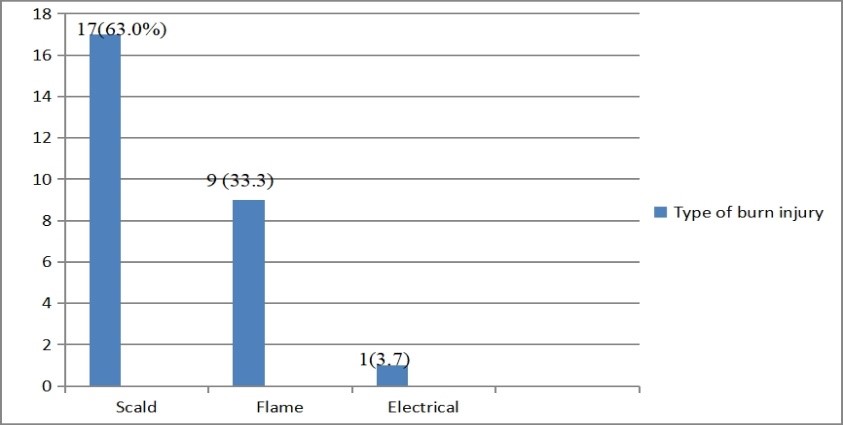
Twenty-seven children were admitted with burn injuries, representing 0.4% of paediatric admissions during the study period. The median age was 24 months, and males predominated (59.3%). Scald injury was the commonest type of burn (63.0%), followed by flame burns (33.3%) and electrical burns (3.7%). Most injuries occurred at home (96.3%) and were unintentional (96.3%). Eighteen (66.7%) patients were discharged, seven (25.9%) were discharged against medical advice, one (3.7%) died, and one (3.7%) was referred. Patients with burns involving 21–50% of the total body surface area had significantly longer hospital stays (p = 0.03) and poorer outcomes (p = 0.02).
Conclusion
Childhood burn injuries were predominantly unintentional scald injuries occurring at home among children aged two years and below. Strengthening caregiver education, improving home safety, and expanding health insurance coverage may reduce the burden of childhood burns.
References
Hyder AA. World report on child injury prevention, WHO, UNICEF. Available on www.who.int/violence_injury_prevention/children/en. Accessed 26th September, 2019
World Health Organization. Global Health Estimates 2016 Summary Tables; Global Deaths by Causes, Age and Sex, 2000-2016. Available on http://www.who.int/healthinfo/global_burden_disease/en/ Accessed 17th July, 2020
World Health Organization Burns Available at www. int/newsroom/fact-sheets/details/burns. Accessed 26th September, 2019
Chalya PL, Mabula JB, Dass RM, Giiti G, Chandike AB, Kanumba ES, et al., Pattern of childhood burn injuries and their management outcome at Bugando Medical Centre in North western Tanzania. BMC Res Notes.2011;4:485. Doi: 10.1186/1756-0500-4-485
Fomukong NH, Mefire AC, Beyila G, Lawrence M, Edgar MML, Nkfusai NC, et al., Predictors of mortality of pediatric burn injury in the Douala General Hospital, Cameroon. The Pan African Medical Journal 2019; 33:189 doi: 10.11604/pamj.2019.33189.18498
Olatunya OS, Ogundare EO, Fadare JO, Oluwayemi IO, Agaja OT, Adeyefa BS, et al., The financial burden of sickle cell disease on households in Ekiti Southwest, Nigeria. Clinicoecon Outcomes Res. 2015;7:545-553.
Aregbesola BS, Khan SM. Out –of –pocket payments, catastrophic health expenditures and poverty among households in Nigeria. Int J Health Policy Manag. 2018;7(9):798-806
Oladele AO, Olabanji JK. Burns in Nigeria: A review. Ann Burns Fire Disasters. 2010; 23(3):120-127
Battle CE, Evans V, James K, Guy K, Whitley J, Evans PA. Epidemiology of burns and scalds in children presenting to the emergency department of a regional burn unit: a 7 year retrospective study. Burns Trauma. 2016;4:19. Doi;10.1186/s41038-016-0047-7
Dhopte A, Tiwari VK, Patel P, Bamal R. Epidemiology of pediatric burns and future prevention strategies- a study of 475 patients from a high-volume burn center in North India. Burns& Trauma 2017. Doi.org/10.1186/s41038-016-0067-3
Wang S, Li D, Shen C, Chai J, Zhu H, Lin Y, et al., Epidemiology of burns in Pediatric patients of Beijing city. BMC Paediatrics. 2016.
Mugemana HP, Rogo T. Burns in children admitted at the University Teaching Hospital of Kigali (Chuk), Rwanda: A descriptive study. RMJ 2017;74(1):11-13
Albertyn R, Numangoglu A, Rode H. Pediatric burn care in sub-Saharan Africa. Afr J Trauma 2014;3(2):61-67
Tirmizi SZ, Mirza FH, Mangi P, Yaseen S, Waseem S. Pattern of burn injuries and outcome in children. J Dow Uni Health Sci 2013;7(1):41-45.
Ibeanusi SE, Kejeh B. Burns care in sub-Saharan Africa: Experience from a trauma registry in Nigeria- An observational study. Niger J Orthop Trauma 2018;17:29-33.
Government of Ekiti State. Bureau of Statistics. Digest of Medical and Health 2017. https://ekitistate.gov.ng/executive-council/mdas/bureau-of-statistics/ Accessed 20th July, 2020.
Government of Ekiti State. Bureau of Statistics. Situation of women and children in Ekiti State(An Atlas of Social Indicators) https://www.slideshare.net/EkitiStateDigitalMedia/situation-of-women-and-children-in-ekiti-state-an-atlas-of-social-indicators
Gessesse FG, Yibeltal AY. Epidemiology of burn injury among children’s attended Felegehiwot referral hospital in bahirdar town, amhara regional state, Ethiopia 2017. J. Pediatr Neonatal Care 2020: 10(1): 21-27
Okoro PE, Igwe PO, Ukachukwu AK. Childhood burns in south eastern Nigeria. Afr J PaediatrSurg 2009; 6:24-7
Abubakar ML, Maina DJ, Adebayo WO, Kabir MA, Ibrahim A, Abdulkadir I. Epidemiology of hand burns among children in Zaria, Northwestern Nigeria. Nigerian J PlastSurg 2018; 14: 22-7
Dongo AE, Irekpita EE, Oseghale LO, Ogbebor CE, Iyamu CE, Onuminya JE. A five-year review of burn injuries in Irrua. BMC Health Serv Res 2007;7:171. https://doi.org/10.1186/1472-6963-7-171
Keshavarz M, Javanmardi F, Mohammdi AA. A decade epidemiological study of pediatric burns in south west of Iran. World J PlastSurg 2020; 9(1):67-72.
Al-Shehri M. The pattern of paediatric burn injuries in Southwestern, Saudi Arabia. West African Journal of Medicine 2005; 23(4): 294-9
Zvizdic Z, Becirovic K, Salihagic S, Millisic E, Jonuzi A, Karamustafic A. Epidemiology and clinical pattern of paediatric burns requiring hospitalization in Sarajevo canton bosnia and Herzegovina, 2012-2016. Ann Burns Fire Disasters 2017; 30(4): 250-255.
Gali BM, Madziga AG, Naaya HV. Epidemiology of childhood burns in Maiduguri north-eastern Nigeria. Nigerian Journal of Medicine 2004:13(2):144-7
Alemayehu S, Afera B, Kidanu K, Belete T. Management outcome of burn injury and associated factors among hospitalized children at Ayder Referral Hospital, Tigray, Ethiopia. International Journal of Pediatrics.Volume 2020, Article ID 9136256, 9 pages https://doi.org/10.1155/2020/9136256
Oludiran OO, Umebese PFA. Pattern and outcome of children admitted for burns in Benin City, mid-western, Nigeria. Indian Journal of Plastic Surgery 2009;42(2):189-193.
Merem EC, Twumasi Y, Wesley J, Isokpehi P, Fageir S, Crisler M, et al., Assessing the effects of fuel based lighting: The case of kerosene use and disasters in Nigeria. Public Health Research 2018; 8(1):6-23
Olugbenga SA. Adulterated kerosene burn disaster: The Nigeria experience. Ann Burns Fire Disasters 2005;18(1): 40-44
Forty percent of Nigerians live below the poverty line: Report | News | Al Jazeera [Internet]. [cited 2020 Sep 1]. Available from: https://www.aljazeera.com/news/2020/05/forty-percent-nigerians-live-poverty-line-report-200504141558636.html
Nigeria National Minimum Wage | 2018-2020 Data | 2021-2022 Forecast | Historical [Internet]. [cited 2020 Sep 1]. Available from: https://tradingeconomics.com/nigeria/minimum-wages
Senate approves N18,000 national minimum wage [Internet]. Vanguard News. 2011 [cited 2020 Sep 7]. Available from: https://www.vanguardngr.com/2011/02/senate-approves-n18000-national-minimum-wage/
FG, roll out new salary table [Internet]. Daily Trust. 2019 [cited 2020 Sep 7]. Available from: https://dailytrust.com/fg-roll-out-new-salary-table
Downloads
Details
License
Copyright (c) 2026 Western Nigeria Journal of Medical Sciences

This work is licensed under a Creative Commons Attribution-NonCommercial-NoDerivatives 4.0 International License.