
Breast Necrotizing Fasciitis: Experience from a Resource-Limited Setting
Authors
Files
Key Information
Journal
Published in Vol. 9 No. 1 (2026) of Western Nigeria Journal of Medical Sciences.
WNJMS is published by UNIOSUN Teaching Hospital, Osun State, Nigeria (the training institution of Osun State University, Osogbo, Nigeria). The journal is a peer-reviewed, open-access publication of scholarly research in all fields of medical and health profession.
About the JournalAbstract
Introduction
Necrotizing fasciitis of the breast is an uncommon but life-threatening soft tissue infection that may occur following breast surgery or inadequately treated mastitis. Delayed diagnosis and treatment can result in extensive breast tissue and skin necrosis, severe sepsis, and significant morbidity. This paper describes the clinical presentation, management, and outcomes of breast necrotizing fasciitis in a resource-limited setting and highlight the challenges associated with its management.
Methods
This retrospective study reviewed the records of women managed for breast necrotizing fasciitis between January 2019 and December 2023. Demographic characteristics, clinical presentation, microbiological findings, treatment, complications, and outcomes were analysed using descriptive statistics.
Results
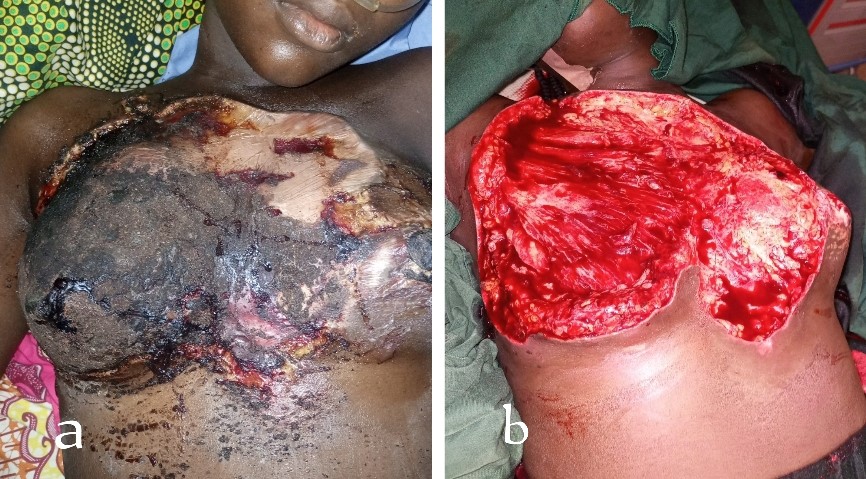
Twenty-six women with a mean age of 27 years were managed during the study period. Most were married, unemployed housewives, and developed necrotizing fasciitis secondary to lactational mastitis (73.1%). All patients presented with ulcerated breast swelling, foul-smelling discharge, and skin necrosis, while breast tissue necrosis occurred in 38.5%. Bilateral breast involvement was observed in 42.3% of patients. Staphylococcus aureus was the commonest organism isolated (34.6%). All patients underwent repeated surgical debridement, with mastectomy performed in five (19.2%) and split-thickness skin grafting in six (23.1%). The mean hospital stay was 22 days, and no mortality was recorded.
Conclusion
Breast necrotizing fasciitis is associated with considerable morbidity, particularly among young women of reproductive age. Early diagnosis, prompt surgical intervention, and appropriate supportive care are essential to minimise complications and improve outcomes.
References
1. Legbo JN, Shehu BB. Necrotizing fasciitis: a comparative analysis of 56 cases. J Natl Med Assoc. 2005;97(12):1692–1697.
2. Fayman K, Wang K, Curran R. A case report of primary necrotising fasciitis of the breast: a rare but deadly entity requiring rapid surgical management. Int J Surg Case Rep. 2017;31:221–224.
3. Cai Y, Cai Y, Shi W, Feng Q, Zhu L. Necrotizing fasciitis of the breast: a review of the literature. Surg Infect (Larchmt). 2020;21(10):881–889.
4. Abur PP, Yusufu LM, Odigie VI. Necrotizing fasciitis of the breast in Ahmadu Bello University Teaching Hospital, Zaria, northwestern Nigeria. Arch Med Surg. 2019;4(1):7–9.
5. McCamley C, Bozin M, Tasevski R, Mann B. Post-partum necrotizing fasciitis of the breast: a case study. ANZ J Surg. 2021;91(10):2214–2215.
6. Angarita FA, Acuna SA. Bilateral necrotizing fasciitis of the breast following quadrantectomy. Breast Cancer. 2014;21(1):108–114.
7. Flandrin A, Rouleau C, Azar C. First report of necrotising fasciitis of the breast following a core needle biopsy. Breast J. 2009;15(2):199–201.
8. Ward ND, Harris JW, Sloan DA. Necrotizing fasciitis of the breast requiring emergent radical mastectomy. Breast J. 2016;22(4):468–470.
9. Yaji P, Bhat B, Harish E. Primary necrotising fasciitis of the breast: case report and brief review of the literature. J Clin Diagn Res. 2014;8(7):ND07–ND08.
10. Yilmaz KB, Saydam M, Akinci M, Akkoca M, Arikok AT. Primary necrotizing fasciitis of the breast: case series of five patients. J Infect Dev Ctries. 2022;16(5):902–908.
11. Shah J, Sharma A, O'Donoghue J, Mearns B, Johri A, Thomas V. Necrotising fasciitis of the breast: case report. Br J Plast Surg. 2001;54(1):67–68.
12. Alasi MA, Aqyil NP, Oyeleke A, Yahaya M, Taiwo OA, Legbo JN. Clinical presentation and treatment outcomes of necrotizing fasciitis: a prospective comparative study of children and adults in Sokoto. J West Afr Coll Surg. 2025;15:59–67.
13. Misiakos EP, Bagias G, Patapis P, Sotiropoulos D, Kanavidis P, Machairas A. Current concepts in the management of necrotizing fasciitis. Front Surg. 2014;1:36.
14. Adigun IA, Nasir AA, Aderibigbe AB. Fulminant necrotizing fasciitis following the use of herbal concoction: a case report. J Med Case Rep. 2010;4:326.
15. Yang B, Connolly S, Ball W. Necrotising fasciitis of the breast: a rare primary case with conservation of the nipple and literature review. JPRAS Open. 2015;6:15–19.
16. Lee J, Lee KJ, Sun WY. Necrotizing fasciitis of the breast in a pregnant woman successfully treated using negative-pressure wound therapy. Ann Surg Treat Res. 2015;89(2):102–106.
17. Kataria K, Srivastava A, Dhar A. Management of lactational mastitis and breast abscesses: review of current knowledge and practice. Indian J Surg. 2013;75(6):430–435.
18. Wong CH, Wang YS. The diagnosis of necrotizing fasciitis. Curr Opin Infect Dis. 2005;18(2):101–106.
Downloads
Details
License
Copyright (c) 2026 Western Nigeria Journal of Medical Sciences

This work is licensed under a Creative Commons Attribution-NonCommercial-NoDerivatives 4.0 International License.