Knowledge, attitude and willingness towards organ donation and transplantation among medical students in a tertiary institution in Nigeria
Authors
Busayo Adetunji, Faith Atewologun, Jesutofunmi Akinwale, Ayomide Fagbenro, Enoch Peter, Tawakalit Adeyemi, Oluwatosin Ruth Ilori, Ebenezer Folorunso, RA AdegokeFiles
Key Information
Journal
Published in Vol. 8 No. 2 (2025) of Western Nigeria Journal of Medical Sciences.
WNJMS is published by UNIOSUN Teaching Hospital, Osun State, Nigeria (the training institution of Osun State University, Osogbo, Nigeria). The journal is a peer-reviewed, open-access publication of scholarly research in all fields of medical and health profession.
About the JournalAbstract
Introduction: Organ donation and transplant have become one of the greatest advances in medical science. It is increasingly used worldwide as a treatment protocol for end-stage organ failure and disease. The aim of this study is to assess the knowledge, attitude and willingness towards organ donation and transplantation among medical students in Ladoke Akintola University of Technology, Ogbomosho, Oyo State.
Methods: This is a cross-sectional study using a quantitative method of data collection. A semi-structured, self-administered questionnaire was used in collection of data from 181 respondents using a multiphase sampling technique. Data was analyzed using IBM SPSS version 27.0 at 95% significance with a p-value of <0.05. Quantitative data were presented using frequency distribution tables, graphs, and charts and association between categorical variables was assessed using chi-square.
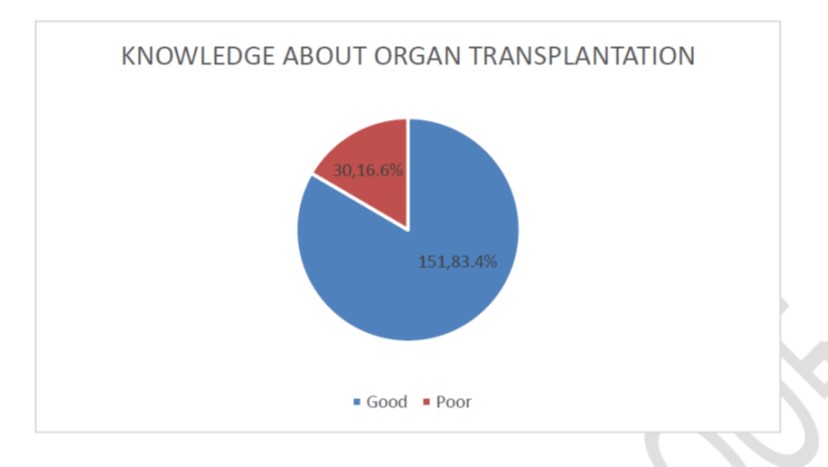
Results: This study showed that majority of the respondents (154, 83.7%) possess good knowledge of organ donation while a few (30, 16.3%) exhibit poor knowledge. In this study, 51.6% (95) of respondents are not willing to donate their organs, but 48.4% (89) are willing to donate. Academic level of respondents was statistically significant with both knowledge as well as attitude towards organ donation and transplantation. The reason 62 (33.7%) of respondents are not willing to donate their organs is because they feel organ donation can lead to death.
Conclusion: Academic level of respondents was statistically associated with knowledge and attitude towards organ transplantation. Health education in raising the awareness of the shortage and subsequent need of organ donation and transplantation is needed.
References
Parsa P, Taheri M, Rezapur-Shahkolai F, Shirahmadi S. Attitudes of Iranian students about organ donation: A qualitative study. BMC Med Ethics. 2019; 20(2):1–11.
Fantu Kerga Dibaba, Kabaye Kumela Goro, …Eshetu Mulisa Bobasa. Knowledge, attitude and willingness to donate organ among medical students of Jimma University, Jimma Ethiopia: cross-sectional study. BMC Public Health. 2020; 20(799):15–22.
Lewis A, Koukoura A, Georgios-Ioannis Tsianos AAG, Nielsen AA, Vassiliadis E. Organ donation in the US and Europe: The supply vs demand imbalance. Transplant Rev. 2021; 35(2):100585.
K-Sotto. Types of Organ Donations [Internet]. 2023. Available from: https://ksotto.kerala.gov.in/types-of-organ-donations/. Accessed December 20, 2024.
Nordham KD, Ninokawa S. The history of organ transplantation. Baylor Univ Med Cent. 2021; 35(1):124–128.
David B. Olawade A, Marinze S, Qureshi N, Teke J. Transforming organ donation and transplantation: Strategies for increasing donor participation and system efficiency. Eur J Intern Med. 2025; 133:14–24.
Bai Y, Yao L, Wei T, Tian F, Jin DY, Chen L. Presumed Asymptomatic Carrier Transmission of COVID-19. JAMA. 2020; 323(14):1406–7.
DiBlasi R, Gallo C, González J, Villarreal C, Evaluating the performance of a nonelectronic, versatile oxygenating perfusion system across viscosities representative of clinical perfusion solutions used for organ preservation. Bioengineering. 2022; 10:2–10.
Baldo M, Aggleton PSG. Does sex education lead to earlier or increased sexual activity in youth? In Berlin: Global Programme on AIDS/ WHO; 2004. 5–7.
Agwu NP, Awosan KJ, Ukwuani SI, Oyibo EU, Makusidi MA, Ajala RA. Awareness and attitude to deceased kidney donation among health care workers in Sokoto, Nigeria. Ann Afr Med. 2018; 5(4):75–81.
Umana E, Grant O, Curran E, May P, Mohammed A, O’Donnell J. Attitudes and knowledge of healthcare professionals regarding organ donation. A survey of the Saolta University Health Care Group. 838. Ir Med J. 2018; 5(4):838.
Sulania A, Sachdeva S, Jha D, Kaur G, Sachdeva R. Organ donation and transplantation: An updated overview. MAMC J Med Sci. 2016; 2(5):18–27.
Jothula KY, Sreeharshika D. Study to assess knowledge, attitude and practice regarding organ donation among interns of a medical college in Telangana, India. IJCMPH. 2018; 5(15):1339–1345.
Khalid F, Khalid AB, Muneeb D, Shabir A, Fayyaz D, Khan M. Level of knowledge and attitude regarding organ donation: a community-based study from Karachi, Pakistan. BMC Res Notes. 2019; 12:309.
Vinay KV, Beena N, Sachin KS, Praveen S. Changes in knowledge and attitude among medical students towards organ donation and transplantation. Int J Anat Res. 2016; 4(3):2873–2877.
Downloads
Details
License
Copyright (c) 2025 Western Nigeria Journal of Medical Sciences

This work is licensed under a Creative Commons Attribution-NonCommercial-NoDerivatives 4.0 International License.