
Clinical characteristics and predictors of mortality among patients with severe COVID-19 admitted to an Intensive Care Unit in Lagos, Nigeria
Authors
Akinsanya Daniel Olusegun-Joseph, Emmanuel Y Nkanor, Bolanle O. Okunowo, Olayinka Oladunjoye, Adeyemi S. Johnson, Kofo OgunyankinFiles
Key Information
Journal
Published in Vol. 9 No. 1 (2026) of Western Nigeria Journal of Medical Sciences.
WNJMS is published by UNIOSUN Teaching Hospital, Osun State, Nigeria (the training institution of Osun State University, Osogbo, Nigeria). The journal is a peer-reviewed, open-access publication of scholarly research in all fields of medical and health profession.
About the JournalAbstract
Introduction:
Coronavirus disease 2019 (COVID-19) remains an important cause of severe illness and mortality worldwide. Patients requiring intensive care frequently have underlying comorbidities and multiple organ dysfunction, which adversely influence clinical outcomes. This study evaluated the clinical characteristics, laboratory findings, and predictors of mortality among patients with severe COVID-19 admitted to an intensive care unit (ICU) in Lagos, Nigeria.
Methods:
This retrospective descriptive study reviewed the medical records of adult patients with confirmed COVID-19 admitted into the ICU of First Cardiology Consultants Hospital, Lagos. Demographic characteristics, clinical features, comorbidities, laboratory parameters, and treatment outcomes were extracted and analysed using SPSS version 25. Factors associated with mortality were assessed using appropriate statistical tests and multivariable logistic regression. Statistical significance was set at p <0.05.
Results:
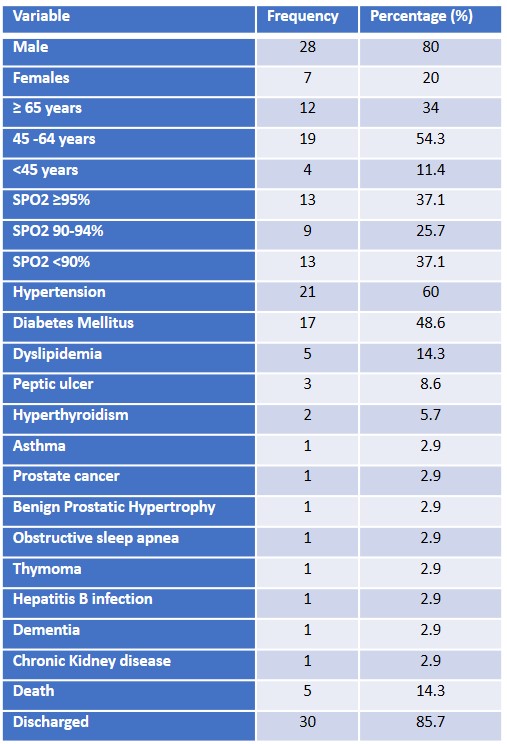
Thirty-five patients were included, comprising 28 (80.0%) males and 7 (20.0%) females, with a mean age of 58.4 ± 13.5 years. Hypertension (60.0%) and diabetes mellitus (48.6%) were the commonest comorbidities. Overall mortality was 14.3%. Non-survivors were significantly more likely to have tachycardia, hypertension, hypoxaemia, renal dysfunction, hepatic dysfunction, elevated C-reactive protein, elevated D-dimer, and impaired renal function. Multivariable analysis identified tachycardia as an independent predictor of mortality (p=0.031).
Conclusion:
Severe COVID-19 requiring intensive care was associated with a high burden of comorbidities and organ dysfunction. Tachycardia emerged as an independent predictor of mortality, while hypoxaemia, hypertension, renal dysfunction, and hepatic dysfunction were significantly associated with poor outcomes. Early identification and aggressive management of these high-risk features may improve survival among critically ill patients with COVID-19.
References
1) Chang, M.C., Park Y, Kim, B, Park D. et al. Risk factors for disease progression in COVID-19 patients. BMC Infect Dis 20, 445 (2020). https://doi.org/10.1186/s12879-020-05144-x.
2) WHO Novel coronavirus – China. Jan 12, 2020. http://www.who.int/csr/don/12-january-2020-novel-coronavirus-china/en/.
3) CDC. Coronavirus disease 2019 (COVID 19). Interim Clinical Guidance for Management of Patients with Confirmed Coronavirus Disease (COVID-19). https://www.cdc.gov/coronavirus/2019-ncov/hcp/clinical-guidance-management-patients.html.
4) World Health Organization: Coronavirus disease 2019 (COVID-19) Situation Report –52. https://www.who.int/docs/default-source/coronaviruse/situation-reports/20200312-sitrep-52-covid-19.pdf?sfvrsn=e2bfc9c0_4.
5) Armstrong RA, Kane AD, Cook TM. Outcomes from intensive care in patients with COVID-19: a systematic review and meta-analysis of observational studies. Anaesthesia. 2020;75(10):1340-1349. doi:10.1111/anae.15201.
6) The epidemiological characteristics of an outbreak of 2019 novel coronavirus diseases (COVID-19)—China, 2020. China CDC Weekly. 2020;2:10.Google Scholar
7) Wiersinga WJ, Rhodes A, Cheng AC, Peacock SJ, Prescott HC. Pathophysiology, Transmission, Diagnosis, and Treatment of Coronavirus Disease 2019 (COVID-19): A Review. JAMA. 2020;324(8):782–793. doi:10.1001/jama.2020.12839.
8) World Health Organisation. Clinical Management of Severe Acute Respiratory Infection (SARI) when COVID-19 Disease is Suspected - Interim Guidance. WHO, 13 March 2020.
9) Temgoua MN, Endomba FT, Nkeck JR, Kenfack GU, Tochie JN, Essouma M. Coronavirus Disease 2019 (COVID-19) as a Multi-Systemic Disease and its Impact in Low- and Middle-Income Countries (LMICs) [published online ahead of print, 2020 Jul 20]. SN Compr Clin Med. 2020;1-11. doi:10.1007/s42399-020-00417-7
10) Kim L, Garg S, O'Halloran A, Whitaker M, Pham H, Anderson EJ, etal. Risk Factors for Intensive Care Unit Admission and In-hospital Mortality Among Hospitalized Adults Identified through the US Coronavirus Disease 2019 (COVID-19)-Associated Hospitalization Surveillance Network (COVID-NET), Clinical Infectious Diseases, ciaa1012, https://doi.org/10.1093/cid/ciaa1012.
11) Akase IE, Akintan PE, Otrofanowei E, Olopade OB, Olorunfemi G, Opawoye A, et al. Clinical predictors of Covid-19 mortality in a tertiary hospital in Lagos, Nigeria: A retrospective cohort study. Niger J Clin Pract 2023;26:424-31.
12) Wang D, Hu B, Hu C, Zhu F, Liu X, Zhang J, et al. Clinical characteristics of 138 hospitalized patients with 2019 novel coronavirus–infected pneumonia in Wuhan, China.JAMA. 2020; 323:1061–1069. doi: 10.1001/jama.2020.1585.
13) Kloka JA, Blum LV, Old O, Zacharowski K, Friedrichson B. Characteristics and mortality of 561,379 hospitalized COVID-19 patients in Germany until December 2021 based on real-life data. Sci Rep 12, 11116 (2022). https://doi.org/10.1038/s41598-022-15287-3.
14) Bounds EJ, Kok SJ. D Dimer. [Updated 2022 Jul 11]. In: StatPearls [Internet]. Treasure Island (FL): StatPearls Publishing; 2022 Jan-. Available from: https://www.ncbi.nlm.nih.gov/books/NBK431064/
15) Osibogun A, Balogun M, Abayomi A, Idris J, Kuyinu Y, Odukoya O, etal. Outcomes of COVID-19 patients with comorbidities in southwest Nigeria. PLoS One. 2021 Mar 15;16(3):e0248281. doi: 10.1371/journal.pone.0248281. PMID: 33720975; PMCID: PMC7959379.
16) Abayomi A, Odukoya O, Osibogun A, Wright O, Adebayo B, Balogun M, etal. Presenting Symptoms and Predictors of Poor Outcomes Among 2,184 Patients with COVID-19 in Lagos State, Nigeria. Int J Infect Dis. 2021 Jan;102:226-232. doi: 10.1016/j.ijid.2020.10.024. Epub 2020 Oct 16. PMID: 33075534; PMCID: PMC7566672.
17) Zheng, YY., Ma, YT., Zhang, JY, Xie X. COVID-19 and the cardiovascular system. Nat Rev Cardiol 2020:17, 259–260 (2020). https://doi.org/10.1038/s41569-020-0360-5.
18) Njenga MK, Dawa J, Nanyingi M, Gachohi J, Ngere I, Letko M, et al. . Why is there low morbidity and mortality of covid-19 in Africa. Am J Trop Med Hygiene 2020;2:564–569.
19) Murray, S.M., Ansari, A.M., Frater, J. et al. The impact of pre-existing cross-reactive immunity on SARS-CoV-2 infection and vaccine responses. Nat Rev Immunol 23, 304–316 (2023). https://doi.org/10.1038/s41577-022-00809-x
20) Moozhipurath, R.K., Kraft, L. & Skiera, B. Evidence of protective role of Ultraviolet-B (UVB) radiation in reducing COVID-19 deaths. Sci Rep 10, 17705 (2020). https://doi.org/10.1038/s41598-020-74825-z.
21) White, J. H. Vitamin D signaling, infectious diseases, and regulation of innate immunity. Infect. Immun. 76, 3837–3843 (2008).
22) Charoenngam, N. & Holick, M. F. Immunologic effects of vitamin D on human health and disease. Nutrients 12, 2097 (2020).
23) Ayanshina OA, Adeshakin AO, Afolabi LO, et al. Seasonal variations in Nigeria: understanding COVID-19 transmission dynamics and immune responses. Journal of Global Health Reports. 2020;4:e2020084. doi:10.29392/001c.14600
24) Xu J, Yang J, Chen J, Luo Q, Zhang Q, Zhang H. Vitamin D alleviates lipopolysaccharide-induced acute lung injury via regulation of the renin-angiotensin system. Mol. Med. Rep. 16, 7432–7438 (2017).
25) Cheng, H., Wang, Y. & Wang, G.-Q. Organ-protective effect of angiotensin-converting enzyme 2 and its effect on the prognosis of COVID-19. J. Med. Virol. 92, 726–730 (2020).
26) Olusegun-Joseph A, Okunowo B, Karaye K, Akintunde A. Prevalence and Pattern of Electrolyte Imbalance in Hypertensives Admitted in Nigerian Teaching Hospitals. International Cardiovascular Forum Journal 2020;21:22-29.
DOI: 10.17987/icfj.v21i0.741.
27) Cierpka-Kmieć K, Hering D. Tachycardia: The hidden cardiovascular risk factor in uncomplicated arterial hypertension. Cardiol J. 2019;10.5603/CJ.a2019.0021.doi: 10.5603/CJ.a2019.0021.
28) Baygin O, Kararmaz A. Sepsis and Tachycardia: Etiologic Factors and Effects on Prognosis. J Anesth Ther. 2018; 1: 103.
29) Guz D, Buchritz S, Guz A, Ikan A, Babich T, Daitch V, etal. β-Blockers, Tachycardia, and Survival Following Sepsis: An Observational Cohort Study. Clin Infect Dis. 2021; 73(4):e921-e926.doi: 10.1093/cid/ciab034. PMID: 33460429.
Downloads
Details
License
Copyright (c) 2026 Western Nigeria Journal of Medical Sciences

This work is licensed under a Creative Commons Attribution-NonCommercial-NoDerivatives 4.0 International License.