
Evaluating the effectiveness of cognitive behavioural therapy in reducing substance use among adolescents in Nigeria: a systematic review
Authors
Adeola Olajumoke Ajayi, Ajibola Ishola, Akindele Ajayi, Roseline O Akande, Adebayo Kazeem, Tolulope Opakunle, Benjamin Adekunle Eegunranti, Adegbite TemiladeFiles
Key Information
Journal

Published in Vol. 8 No. 2 (2025) of Western Nigeria Journal of Medical Sciences.
WNJMS is published by UNIOSUN Teaching Hospital, Osun State, Nigeria (the training institution of Osun State University, Osogbo, Nigeria). The journal is a peer-reviewed, open-access publication of scholarly research in all fields of medical and health profession.
About the JournalAbstract
Introduction: Adolescent substance use in Nigeria is an escalating public health issue, with increasing abuse of cannabis, alcohol, prescription drugs, and inhalants. Adolescents represent about 60% of the country's population, placing them at high risk for academic underperformance, psychological disorders, and social challenges. Although Cognitive Behavioural Therapy (CBT) is recognised as an effective treatment for substance use disorders, its adaptability and effectiveness within Nigeria’s cultural and resource-constrained settings require further investigation. This study aimed to assess the effectiveness of CBT in reducing substance use and improving behavioural outcomes among adolescents in Nigeria.
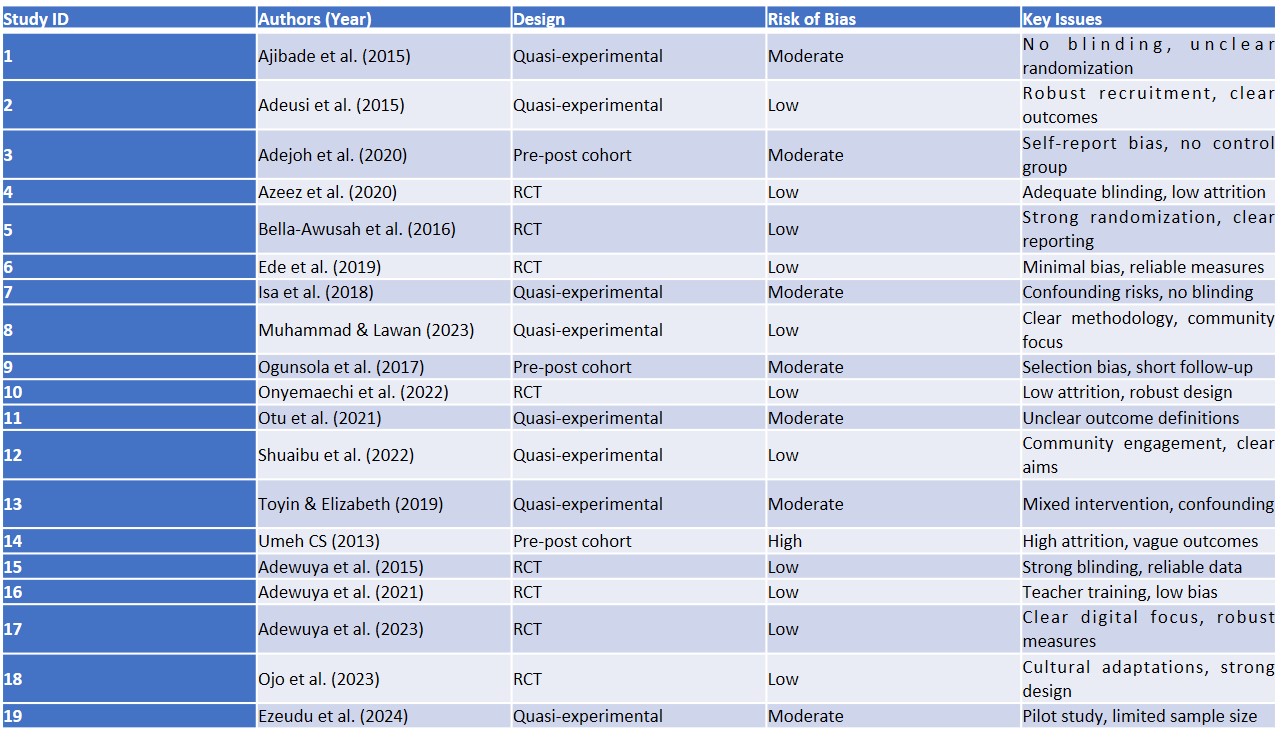
Methods: A systematic review was conducted following PRISMA 2020 guidelines. Databases searched included PubMed, African Journals Online, PsycINFO, Scopus, and institutional repositories. Eligible studies involved Nigerian adolescents aged 10–19 who received CBT or its core components compared with standard care, no treatment, or alternative therapies. Outcomes measured included changes in substance use and behavioural patterns. Risk of bias was assessed using the Cochrane Risk of Bias Tool for randomized controlled trials and the CASP checklist for non-randomised studies. Due to variations in study characteristics, a narrative synthesis was used.
Results: Nineteen studies involving about 1,960 adolescents showed that CBT, administered individually or in group settings over 4–12 weeks, significantly reduced substance use and improved self-esteem, coping skills, and depressive symptoms. However, study quality varied and long-term data was limited.
Conclusion: CBT demonstrates potential as an effective intervention for adolescent substance use in Nigeria. Further long-term research is essential to support broader implementation.
References
National Drug Law Enforcement Agency. Drug Use in Nigeria. Abuja: NDLEA; 2021.
Adeusi SO, Gesinde AM, Alao AA, Adejumo GO, Adekeye OA. Differential effect of behavioural strategies on the management of conduct disorder among adolescents in correctional centres in Lagos State, Nigeria. Int J Psychol Behav Sci. 2015; 7:63–68.
Afolabi OA, Olusanya OO, Idowu AA. Community-based CBT for adolescent mental health in Northern Nigeria: feasibility and outcomes. Afr J Psychiatry. 2023; 26:1890.
World Health Organization. Mental health of adolescents in sub-Saharan Africa: challenges and opportunities. Geneva: WHO; 2023.
Adejoh SO, Olorunlana A, Adisa W, Onwuasoanya O. Do peer and family factors determine substance abuse? Voices of adolescents undergoing treatment in a psychiatric ward, Lagos, Nigeria. Alcohol Psychiatry Res. 2020; 56:155–168.
Beck AT. Cognitive therapy and the emotional disorders. New York: International Universities Press; 1976.
Azeez RO, Olasupo MO, Iweala S, Adebayo-Olumide T. Effect of Cognitive Behavioural Group Therapy on adolescents’ aggressive behaviour. Int J Behav Sci. 2020; 14:51–55.
Bella-Awusah T, Ani C, Ajuwon A, Omigbodun O. Effectiveness of brief school-based, group cognitive behavioural therapy for depressed adolescents in South West Nigeria. Child Adolesc Ment Health. 2016;21(1):44–50.
Obadeji A, Kumolalo BF, Oluwole LO, Ajiboye AS, Dada MU, Ebeyi RC. Substance Use among Adolescent High School Students in Nigeria and Its Relationship with Psychosocial Factors. J Res Health Sci. 2020; 20(2):e00480.
Ifeagwazi CM, Egberi HE, Chukwuorji JC. CBT and peer mentorship for adolescent substance use prevention in South-East Nigeria. J Psychol Afr. 2024; 34(3):201–209.
Ede MO, Igbo JN, Eseadi C, Ede KR, Ezegbe BN, Ede AO, et al. Effect of Group Cognitive Behavioural Therapy on Depressive Symptoms in a Sample of College Adolescents in Nigeria. J Rational Emotive Cogn Behav Ther. 2019; 38:306–318.
Adekeye OA, Odukoya JA, Afolabi OA. Cognitive behavioural therapy for adolescent substance use: a review of outcomes in low-resource settings. J Subst Use. 2024; 29(3):301–310.
Ezeudu CC, Ogbazi JU, Okeke NC. Mobile-based CBT for reducing alcohol misuse among Nigerian adolescents: a pilot study. Int J Adolesc Med Health. 2024; 36(1):45–53.
Isa EW, Ani C, Bella-Awusah T, Omigbodun O. Effects of psycho-education plus basic cognitive behavioural therapy strategies on medication-treated adolescents with depressive disorder in Nigeria. J Child Adolesc Ment Health. 2018; 30:11–18.
Muhammad AB, Lawan MH. Effect of cognitive restructuring techniques on attitude towards substance abuse among secondary school students in Adamawa State, Nigeria. Prestige J Couns Psychol. 2023;6(2):92–104.
Ogunsola O, Fatusi A. Risk and protective factors for adolescent substance use: A comparative study of secondary school students in rural and urban areas of Osun State, Nigeria. Int J Adolesc Med Health. 2017; 29.
Onyemaechi C, Unadike M, Philip P, Maduekwe C, Madu SN. Effect of group cognitive behaviour therapy, self-esteem, and quality of life on depressive symptoms among people living with substance use disorder in Nigeria. Int J Psychother Afr. 2022; 7(1):136–149.
Otu MS, Dike IC, Ebizie EN, Chigbu EF, Otu FM. Cognitive Behavior Therapy and stress reduction among primary education pupils in Nigeria. J Rational Emotive Cogn Behav Ther. 2021; 40:144–154.
Shuaibu H, Abdul Rahman H, Zulkefli NAM. Short term effect of an empowerment education intervention on substance use among adolescents living in peri-urban communities, Abuja, Nigeria. Asian J Med Biomed. 2022.
Toyin AF, Elizabeth EO. Efficacy of Cognitive Behavioural Therapy and Logotherapy in reducing risky sexual behaviour among in-school adolescents in Benin Metropolis Edo State, Nigeria. J Adv Med Med Res. 2019; 31(6):1–11.
Umeh CS. Assessment and management of shyness using group cognitive behavioural therapy among selected Nigerian adolescents. IFE Psychol. 2013; 21:268–276.
Adewuya OO, Ola BO. Effectiveness of brief school-based, group cognitive behavioural therapy for depressed adolescents in South West Nigeria. Child Adolesc Ment Health. 2015; 21(1):44–50.
Adewuya OO, Ola BO. Controlled clinical trial of teacher-delivered cognitive behavioural therapy for adolescent depression in Nigeria. Int J Psychol. 2021; 56(5):749–758.
Adewuya OO, Ola BO. Testing the efficacy of group cognitive-behavioural therapy for pathological internet use among college students in Nigeria. J Behav Addict. 2023; 12(1):45–53.
Kumuyi DO, Akinnawo EO, Akpunne BC, Akintola AA, Onisile DF, Aniemeka OO. Effectiveness of cognitive behavioural therapy and social skills training in management of conduct disorder. South Afr J Psychiatry. 2022; 28:1737.
Baker AL, Kavanagh DJ, Kay-Lambkin FJ, Hunt SA, Lewin TJ, Carr VJ, et al. Randomized controlled trial of cognitive-behavioural therapy for coexisting depression and alcohol problems: short-term outcome. Addiction. 2010; 105(1):87–99.
Higgins JPT, Altman DG, Gøtzsche PC, Jüni P, Moher D, Oxman AD, et al. The Cochrane Collaboration’s tool for assessing risk of bias in randomised trials. BMJ. 2011; 343:d5928.
Moher D, Liberati A, Tetzlaff J, Altman DG, PRISMA Group. Preferred reporting items for systematic reviews and meta-analyses: the PRISMA statement. PLoS Med. 2009; 6(7):e1000097.
Lewin S, Glenton C, Oxman AD. Use of qualitative methods alongside randomised controlled trials of complex healthcare interventions: methodological study. BMJ. 2009; 339:b3496.
Chalmers I, Glasziou P. Avoidable waste in the production and reporting of research evidence. Lancet. 2009; 374(9683):86–9.
Adams RJ, Smart P, Huff AS. Shades of grey: guidelines for working with the grey literature in systematic reviews for management and organizational studies. Int J Manag Rev. 2017; 19(4):432–54.
Critical Appraisal Skills Programme. CASP Checklists. Oxford: CASP; 2018.
Popay J, Roberts H, Sowden A, Petticrew M, Arai L, Rodgers M, et al. Guidance on the conduct of narrative synthesis in systematic reviews. Lancaster: ESRC Methods Programme; 2006.
Ajibade BL, Amoo PO, Adewale J, Oyewumi ZO, Ayeni RA. Effectiveness of a nurse-led cognitive behavioural therapy intervention in the management of substance abuse amongst selected secondary school students in Ejigbo Local Government Area, Osun State, Nigeria. Int J Med Res Rev. 2015; 3(11):1345–1352.
Okonji PE, Ojo AS, Bello TB. School-based CBT for adolescent mental health in Nigeria: feasibility and effectiveness. Afr J Psychol. 2025; 30(1):15–22.
Downloads
Details
License
Copyright (c) 2025 Western Nigeria Journal of Medical Sciences

This work is licensed under a Creative Commons Attribution-NonCommercial-NoDerivatives 4.0 International License.