
Cobalt chloride attenuated unhealed gastric ulceration in male Wistar rats: role of blood inflammatory markers
Authors
Adeola Salami, Oluwatoyin Bello, Mayokun Adelakun, Juliet UdechukwuFiles
Key Information
Journal
Published in Vol. 8 No. 2 (2025) of Western Nigeria Journal of Medical Sciences.
WNJMS is published by UNIOSUN Teaching Hospital, Osun State, Nigeria (the training institution of Osun State University, Osogbo, Nigeria). The journal is a peer-reviewed, open-access publication of scholarly research in all fields of medical and health profession.
About the JournalAbstract
Introduction: Gastric ulcer (GU) relapses in healing with symptoms of anaemia, mostly in those with prolonged use of antacids. The gastroprotective and facilitated healing of experimental gastric ulcer by Cobalt chloride (CoCl2) have been documented. However, its activities during GU relapse using the Delayed Gastric Ulcer (DGU) healing model are unknown which this study evaluates.
Methods: Seventy-five (75) male Wistar rats (120–150g; n=15) were grouped, 1-Delayed Ulcer untreated (DUn), II, III, IV, and V treated with 62mg/kg, 25mg/kg CoCl2, 1mg/kg vitamin C and 1mg/kg misoprostol respectively after inducing DGU. On treatment days 3, 7 and 14 ocular vein was puncture for blood collection and analysis; thereafter, animals were sacrificed while GU scoring, biochemical analysis and histological evaluation on excised stomach tissues were done. Results were analyzed statistically using analysis of variance.
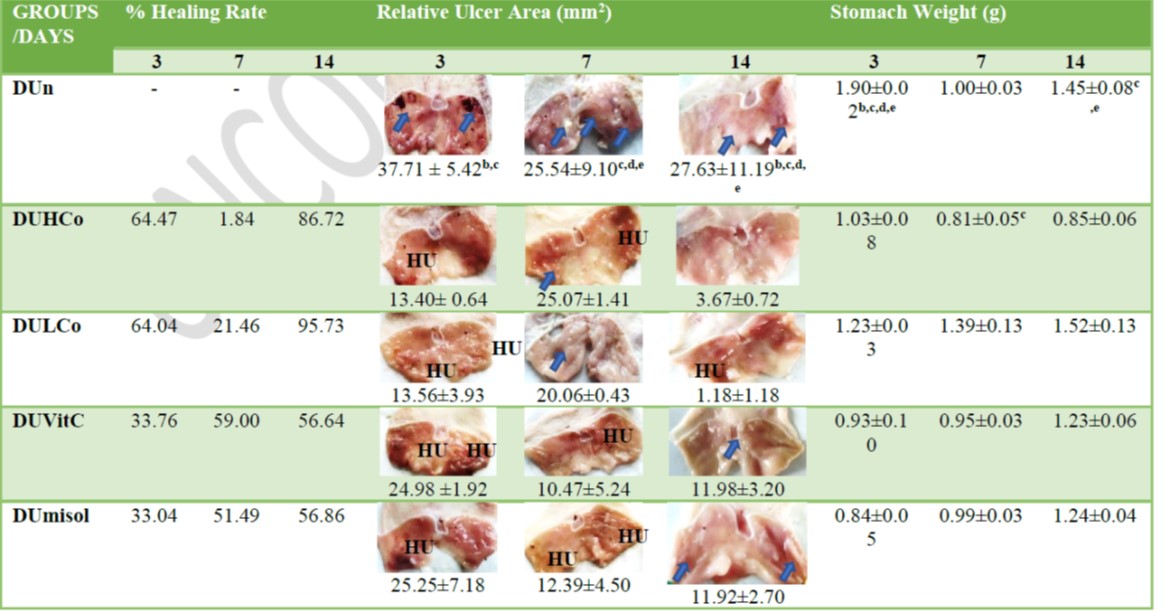
Results: Haemoglobin content, PCV, RBC, and Platelet counts significantly increased by day 3 but WBC count reduced by days 7 and 14 in DUn compared with other groups. Neutrophil/lymphocytes, Monocytes/lymphocytes, and Platelet/lymphocyte significantly increased in DUn compared with CoCl2 groups. Platelet/lymphocyte significantly increased in CoCl2-treatment compared with DUn on days 14. The ulcer score, superoxide dismutase activities, nitric-oxide level, Parietal and mucosa cells significantly decreased but MDA level increased in DUn compared with CoCl2 on days 3, 7, and 14. Histological evaluation revealed healing with preserved epithelial cells and architecture from day7 in CoCl2 groups.
Conclusion: Cobalt chloride attenuated unhealed gastric ulcer and associated anemia via reduced blood inflammatory markers, nitric oxide levels, and mucous cell count.
References
Battaglia G, Di Mario F, Piccoli A, Vianello F, Farinati F, Naccarato R. Clinical markers of slow healing and relapsing gastric ulcer. Gut. 1987; 28(2):210-5. doi: 10.1136/gut.28.2.210. PMID: 3557191; PMCID: PMC1432970.;
Wang SY, Wang HY, Wang TE , Wang HH, Chang WH , Chu CH , et al. Delayed healing of gastric ulcer is associated with downregulation of connexin 32 in the gastric mucosa, Advances in Digestive Medicine 2015; 2(2):67-73, ISSN 2351-9797, https://doi.org/10.1016/j.aidm.2015.01.004.
Okabe S, Amagase K. An overview of acetic acid ulcer models-the history and state of the art of peptic ulcer research. Biol Pharm Bull. 2005; 28(8):1321-41. doi: 10.1248/bpb.28.1321. PMID: 16079471.
Salami AT, Adeola BO, Iyiola TO, Omayone TP, Oluwole FS, Olaleye SB. Antioxidative action of Manganese treatment in delayed healing of acetic acid induced ulceration in rat stomach. Journal of African Association of Physiological Sciences. 2015; 3(2): 67-78
Wang JY, Yamasaki S, Takeuchi K, Okabe S. Delayed healing of acetic acid-induced gastric ulcers in rats by indomethacin. Gastroenterology. 1989; 96(2 Pt 1):393-402. doi: 10.1016/0016-5085(89)91563-1. PMID: 2910759.
Amang AP, Mezui C, Siwe GT, Emakoua J, Mbah G, Nkwengoua EZ, et al. Healing and Antisecretory Effects of Aqueous Extract of Eremomastax speciosa (Acanthaceae) on Unhealed Gastric Ulcers. BioMed Research International. 2017; 1:1924320. https://doi.org/10.1155/2017/1924320
Albert-Bayo M, Paracuellos I, González-Castro AM, Rodríguez-Urrutia A, Rodríguez-Lagunas MJ, Alonso-Cotoner C, et al. Intestinal Mucosal Mast Cells: Key Modulators of Barrier Function and Homeostasis. Cells. 2019; 8(2):135. https://doi.org/10.3390/cells8020135
Ito M, Segami T, Inagguma K, Suzuki Y. Cimetidine and omeprazole accelerate gastric ulcer healing by an increase in gastrin secretion. Eur J Pharmacol. 1994; 263:251–259
Salami AT, James PA, Iyiola, TO, Olaleye SB. Gastric ulcer-healing promoting activity of cobalt chloride in rats. African Journal of Medicine and Medical Sciences. 2018; 47(2): 115-122
Salami AT, Akpamu U, Iyiola TO, Olaleye SB. Cobalt Modulates Healing of Gastric Ulceration in male Wistar Rats: iNOS/COX-2 crosstalk. Nigerian Journal of Pharmaceutical Research. 2024; 20(2).
Obeagu EI, Obeagu GU. Exploring the intersection: Peptic ulcers and hemolysis—Unraveling the complex relationship. Medicine. 2024; 103(11):e37565. https://doi.org/10.1097/MD.0000000000037565
Papatheodoridis GV, Sougioultzis S, Archimandritis AJ. Effects of Helicobacter pylori and nonsteroidal anti-inflammatory drugs on peptic ulcer disease: a systematic review. Clin Gastroenterol Hepatol. 2006; 4:130–142
DeLoughery TG. Microcytic anemia. N Engl J Med. 2014; 371:1324–1331. doi: 10.1056/NEJMra1215361
Cryer B, Mahaffey KW. Gastrointestinal ulcers, role of aspirin, and clinical outcomes: pathobiology, diagnosis, and treatment. J Multidiscip Healthc. 2014; 7:137–146
Haile K, Yemane T, Tesfaye G, Wolde D, Timerga A, Haile A. Anemia and its association with Helicobacter pylori infection among adult dyspeptic patients attending Wachemo University Nigist Eleni Mohammad Memorial Referral Hospital, Southwest Ethiopia: A cross-sectional study. PLoS ONE, 2021; 16(1):e0245168. https://doi.org/10.1371/journal.pone.0245168
Betesh AL, Santa Ana CA, Cole JA. Is achlorhydria a cause of iron deficiency anemia? Am J Clin Nutr. 2015; 102:9–19. 10.3945/ajcn.114.097394
Patel PK, Patel SK, Dixit SK, et al. Gastritis and peptic ulcer diseases in dogs: a review. Int J Curr Microbiol App Sci. 2018; 7:2475–2501.
Papatheodoridis GV, Sougioultzis S, Archimandritis AJ. Effects of Helicobacter pylori and nonsteroidal anti-inflammatory drugs on peptic ulcer disease: a systematic review. Clin Gastroenterol Hepatol. 2006; 4:130–142.
Camaschella C. Iron-deficiency anemia. N Engl J Med. 2015; 372:1832–1843. doi: 10.1056/NEJMra1401038.
Tan H, Goh K. Extragastrointestinal manifestations of Helicobacter pylori infection: Facts or myth? J Dig Dis. 2012; 13:342–349
Jelkmann W. Erythropoietin. Sports Endocrinology. 2016; 47:115-127.
Jelkmann W. Regulation of erythropoietin production. J Physiol. 2011; 15; 589(Pt 6):1251-1258. doi: 10.1113/jphysiol.2010.195057.
Tvermoes BE, Unice KM, Paustenbach DJ, Finley BL, Otani JM, Galbraith DA. Effects and blood concentrations of cobalt after ingestion of 1 mg/d by human volunteers for 90 d. Am J Clin Nutr. 2014; 99(3):632-646. doi: 10.3945/ajcn.113.071449. Epub 2014 Feb 5. PMID: 24500148.
Czarnek K, Terpiłowska S, Siwicki AK. Selected aspects of the action of cobalt ions in the human body. Central-European Journal of Immunology. 2015; 40(2):236. https://doi.org/10.5114/ceji.2015.52837
Houlihan B, Vidar Hanstad D. The effectiveness of the World Anti-Doping Agency: developing a framework for analysis, International Journal of Sport Policy and Politics, 2018; DOI: 10.1080/19406940.2018.1534257
Ebert B, Jelkmann W. Intolerability of cobalt salt as erythropoietic agent. Drug Test Anal. 2014; 6(3):185-189. doi: 10.1002/dta.1528.
Thevis M, Krug O, Piper T, Geyer H, Schänzer W. Solutions advertised as erythropoiesis-stimulating products were found tocontain undeclared cobalt and nickel species. Int J Sports Med. 2016; 37:82-84. doi:10.1055/s-0035-1569350
Nordberg M, Nordberg GF. Trace element research-historical and future aspects. Journal of Trace Elements in Medicine and Biology. 2016; 38:46-52. https://doi.org/10.1016/j.jtemb.2016.04.006
Finley BL, Monnot AD, Gaffney SH, Paustenbach DJ. Dose-response relationships for blood cobalt concentrations and health effects: a review of the literature and application of a biokinetic model. J Toxicol Environ Health B Crit Rev. 2012;15(8):493-523. doi: 10.1080/10937404.2012.744287. Erratum in: J Toxicol Environ Health B Crit Rev. 2013;16(1):67. PMID: 23199219.
Hoffmeister T, Schwenke D, Krug O, Wachsmuth N, Geyer H, Thevis M, Byrnes WC, Schmidt WFJ. Effects of 3 Weeks of Oral Low-Dose Cobalt on Hemoglobin Mass and Aerobic Performance. Front Physiol. 2018; 19(9):1289. doi: 10.3389/fphys.2018.01289. PMID: 30283349; PMCID: PMC6157393.
Hoffmeister T, Schwenke D, Wachsmuth N, Krug O, Thevis M, Byrnes WC, Schmidt WF. Erythropoietic effects of low‐dose cobalt application. Drug testing and analysis. 2019; 11(2), 200-207.
Salami AT, Famurewa AD. Effect of Chrysophyllum albidum bark extract and fractions on delayed gastric ulcer healing and the role of blood inflammatory makers. Archives of Basic and Applied Medicine. 2017; 5(2):77-87.
Salami AT, Adeola BO, Iyiola TO, Omayone TP, Oluwole FS, Olaleye SB. Antioxidative action of Manganese treatment in delayed healing of acetic acid induced ulceration in rat stomach. Journal of African Association of Physiological Sciences. 2015;3(2):67-78.
Salami AT, Odukanmi OA, Faniyan OF, Omayone TP, Olaleye SB. Seeds of Buchholzia coriacea in Diet Mitigate Ischemic Reperfusion-Induced Gastric Ulceration in Experimental Rats. Journal of dietary supplements. 2018; 15(6):842–859. https://doi.org/10.1080/19390211.2017.1404544
Alabi QK, Akomolafe RO, Olukiran OS, Nafiu AO, Omole JG, Adefisayo AM. Et al. “Assessment of Haematological and Biochemical Effects of Kolaviron in Male Wistar Rats”, Journal of Pharmaceutical Research International, 2017; 16(3):1–14. doi: 10.9734/BJPR/2017/33517.
Buonacera A, Stancanelli B, Colaci M, Malatino L. Neutrophil to Lymphocyte Ratio: An Emerging Marker of the Relationships between the Immune System and Diseases. International Journal of Molecular Sciences. 2022; 23(7):3636. https://doi.org/10.3390/ijms23073636
Kim JK, Sun KH. Role of platelet-to-lymphocyte ratio at the time of arrival to the emergency room as a predictor of short-term mortality in trauma patients with severe trauma team activation. Acute Crit Care. 2024; 39(1):146-154. doi: 10.4266/acc.2023.01319
Tarnawski AS, Ahluwalia A. The Critical Role of Growth Factors in Gastric Ulcer Healing: The Cellular and Molecular Mechanisms and Potential Clinical Implications. Cells. 2021; 10(8):1964. doi: 10.3390/cells10081964. PMID: 34440733; PMCID: PMC8392882.
Salami AT, James PA, Iyiola TO, Olaleye SB. Gastric ulcer-healing
promoting activity of cobalt chloride in rats. African Journal of Medicine and Medical
Sciences. 2018; 47(2):115-122.
Clark B, Stewart GB, Panzone LA, Kyriazakis I, Frewer LJ. Citizens, consumers and farm animal welfare: A meta-analysis of willingness-to-pay studies. Food Policy. 2017; 68:112-127. https://doi.org/10.1016/j.foodpol.2017.01.006
Adinortey MB, Ansah C, Galyuon I, Nyarko A. In Vivo Models Used for Evaluation of Potential Antigastroduodenal Ulcer Agents. Ulcers, 2012; 2013(1):796405. https://doi.org/10.1155/2013/796405
Dacie JV, Lewis SM. Practical Haematology 7th edition. ELBS with Churchill Livingstone. Longman group UK. 1994; 5-82:160-175.
Lawal HO, Iyiola TO, Salami AT, Oluwole FS. Gastroprotective Activities of
Canarium schweinfurthii Fruit and Oil Diets: Role of H+/K+ ATPase Activity. Archives of Basic and Applied Medicine. 2024; 12:54-66
Gornall AG, Bardawill CJ. David MM. Determination of serum proteins by means of the biuret reaction. J Biol Chem.1949; 177(2):751-766.
Vashney R, Kale RK. Effects of calmodulin Antagoniss. Int. J Rad. Biol. 1990; 58:733-743
Misra HP, Fridovich I. The role of superoxide anion in the autoxidation of epinephrine and a sample assay for superioxide dismutase. J Biol Chem. 1972; 247:3170-3175.
Ignarro L, Buga G, Wood K, Byrns R, Chaudhuri G. Endothelium derived relaxing factor produced and released from artery and vein is nitric oxide. Proceedings of the National Academy of Sciences USA. 1987; 84:9265–9269.
Oluwole SO, Saka MT. Effect of thyroid hormone on gastric mucous secretion around indomethacin-induced gastric ulcers in rats. J Med Sci. 2007; 7(4):678-681.
Filardo S, Scalese G, Virili C, Pontone S, Pietro MD, Covelli A, et al. The Potential Role of Hypochlorhydria in the Development of Duodenal Dysbiosis: A Preliminary Report. Frontiers in Cellular and Infection Microbiology. 2022; 12:854904. https://doi.org/10.3389/fcimb.2022.854904
Beckett AC, Piazuelo MB, Noto JM, Washington MK, Scott Algood HM, et al. Dietary Composition Influences Incidence of Helicobacter pylori-Induced Iron Deficiency Anemia and Gastric Ulceration. Infection and Immunity. 2016; 84(12):3338. https://doi.org/10.1128/IAI.00479-16
Qi X, De Stefano V, Shao X, Guo X. Thrombocytosis in a patient with upper gastrointestinal bleeding. Intractable Rare Dis Res. 2017; 6(1):69-71. doi: 10.5582/irdr.2016.01080. PMID: 28357187; PMCID: PMC5359359.
Kohutek F, Bystricky B, Kohutekova M. Thrombocytosis and leukocytosis: Are they negative prognostic factors in solid tumours? Annals of Oncology: 2018; 29:viii12 - viii13)
Ohyashiki K, Akahane D, Gotoh A, Ito Y, Tauchi T, Miyazawa K, et al. Uncontrolled thrombocytosis in polycythemia vera is a risk for thrombosis, regardless of JAK2V617F mutational status. Leukemia. 2007; 21(12):2544-2545. https://doi.org/10.1038/sj.leu.2404829
Tefferi A, Barbui T. Polycythemia vera and essential thrombocythemia: 2021 update on diagnosis, risk-stratification and management. Am J Hematol. 2020; 95(12):1599-1613. doi: 10.1002/ajh.26008. Epub 2020 Oct 23. PMID: 32974939.
Lu H, Chiang C. Turn over the new leaf of the treatment in peptic ulcer bleeding: A review of the literature. Therapeutic Advances in Gastroenterology. 2024; https://doi.org/10.1177/17562848241275318
Seleem WM, Hanafy AS. The Additive Effect of Platelet-Rich Plasma in the Treatment of Actively Bleeding Peptic Ulcer. Clinical Endoscopy 2021; 54(6):864-871. DOI: https://doi.org/10.5946/ce.2021.004
Shimoyama Y, Umegaki O, Agui T, et al. Neutrophil to lymphocyte ratio and platelet to lymphocyte ratio are superior to other inflammation-based prognostic scores in predicting the mortality of patients with gastrointestinal perforation. JA Clin Rep. 2017; 3(1):49.
Huabing R, Dong W. The differential diagnosis value of neutrophil/lymphocyte ratio and platelet/lymphocyte ratio in upper digestive tract ulcer perforation. J Clin Emerg. 2020; 21(2):147-152. doi: 10.13201/j.issn.1009-5918.2020.02.010
Farah R, Hamza H. A link between platelet to lymphocyte ratio and Helicobacter pylori infection. Journal of Clinical Laboratory Analysis. 2017; 32(1):e22222. https://doi.org/10.1002/jcla.22222,
Al-Yahri O, Saafan T, Abdelrahman H, Aleter A, Toffaha A, Hajjar M, et al. Platelet to Lymphocyte Ratio Associated with Prolonged Hospital Length of Stay Postpeptic Ulcer Perforation Repair: An Observational Descriptive Analysis. BioMed Research International. 2021:6680414. https://doi.org/10.1155/2021/6680414
Aydin O, Pehlivanli F. Is the platelet to lymphocyte ratio a potential biomarker for predicting mortality in peptic ulcer perforation? Surg Infect(Larchmt). 2019; 20(4):326-331,
Zheng M, Liu Y, Zhang G, Yang Z, Xu W, Chen Q. The Applications and Mechanisms of Superoxide Dismutase in Medicine, Food, and Cosmetics. Antioxidants. 2023; 12(9):1675. https://doi.org/10.3390/antiox12091675
Liang Y, Deng M, Li X, Xu X, Chen G. The role of nitric oxide in peptic ulcer: A narrative review. Medical Gas Research. 2021; 11(1):42. https://doi.org/10.4103/2045-9912.310059
Engevik AC, Kaji I, Goldenring JR. The Physiology of the Gastric Parietal Cell. Physiological Reviews, 2019; 100(2):573. https://doi.org/10.1152/physrev.00016.2019
Tarnawski AS, Ahluwalia A. The Critical Role of Growth Factors in Gastric Ulcer Healing: The Cellular and Molecular Mechanisms and Potential Clinical Implications. Cells. 2021; 10(8):1964. https://doi.org/10.3390/cells10081964
Engevik AC, Feng R, Yang L, Zavros Y. The Acid-Secreting Parietal Cell as an Endocrine Source of Sonic Hedgehog During Gastric Repair. Endocrinology. 2013; 154(12):4627. https://doi.org/10.1210/en.2013-1483
Karam SM. A focus on parietal cells as a renewing cell population. World journal of gastroenterology. 2010; 16(5):538–546. https://doi.org/10.3748/wjg.v16.i5.538
Bockerstett KA, Osaki LH, Petersen CP, Cai CW, Wong CF, Nguyen TM, et al. Interleukin-17A Promotes Parietal Cell Atrophy by Inducing Apoptosis. Cell Mol Gastroenterol Hepatol. 2018; 5:678–690. doi: 10.1016/j.jcmgh.2017.12.012.
Vllahu M, Voli A, Licursi V, Zagami C, D’Amore A, Traulsen J, et al. Inflammation promotes stomach epithelial defense by stimulating the secretion of antimicrobial peptides in the mucus. Gut Microbes. 2024; 16(1): https://doi.org/10.1080/19490976.2024.2390680
Tarnawski AS, Jones MK, Ahluwalia A. Dedifferentiation and reprogramming of epithelial cells during gastric ulcer healing is triggered by hypoxia and a well-coordinated, sequential activation of egfr signaling: Cross talk with IGF1 and COX2. Gastroenterology. 2021; 160:S77–S78. doi: 10.1016/S0016-5085(21)00932-X.
Arakawa T, Watanabe T, Tanigawa T, Tominaga K, Fujiwara Y. Quality of ulcer healing in gastrointestinal tract: Its pathophysiology and clinical relevance. World Journal of Gastroenterology. 2012; 18(35):4811. https://doi.org/10.3748/wjg.v18.i35.4811
Downloads
Details
License
Copyright (c) 2025 Western Nigeria Journal of Medical Sciences

This work is licensed under a Creative Commons Attribution-NonCommercial-NoDerivatives 4.0 International License.