
Factors influencing healthcare workers' acceptance of voluntary COVID-19 PCR testing during the peak of the pandemic: Insights from a Nigerian tertiary facility
Authors
Temitope Olumuyiwa Ojo, Olusola Fajobi, Olusola Joseph Olarewaju, Baderinwa Opeyemi Akanji, Tajudin Adesegun Adetunji, Olufemi Samuel Smith, Olusola Akanni Jeje, Taiwo Samson Olumakinde, Waidi Folorunso Sule, Sunday Babatunde Akinde, Rahman Ayodele BolarinwaFiles
Abstract
Introduction: COVID-19 surveillance among healthcare workers is vital to prevent hospital transmission. This study assessed healthcare workers' willingness to voluntarily test for SARS-CoV-2 infection.
Methods: A cross-sectional study was conducted among 234 staff in a Nigerian tertiary healthcare facility using a 25-item questionnaire to obtain information on sociodemographic/occupational characteristics, willingness to have a COVID-19 PCR test and self-perceived barriers to testing. Data were analyzed using SPSS version 25, with a significance level set at p < 0.05. Associations were tested using odds ratios with a 95% confidence interval.
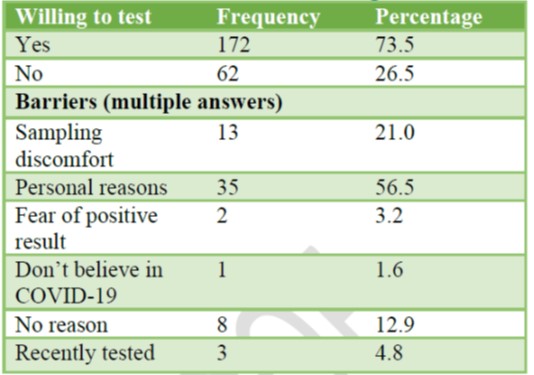
Results: The mean age was 40.1±10.7 years with a male to female ratio of approximately 1:1. More than two-thirds of health workers, 159 (68.0%) perceived they were at high risk for COVID-19. Most health workers, 172 (73.5%) were willing to test voluntarily for COVID-19. For persons not willing to be tested, personal reasons (35; 56.5%) and sampling discomfort (13; 21.0%) were reasons for non-willingness to test. Being married or in a union (OR: 0.32, 95% CI: 0.13-0.76; p=0.011), currently showing symptoms suggestive of COVID-19 (OR: 7.51, 95% CI: 2.191-26.70; p=0.002) and previous COVID-19 vaccination (OR: 3.35, 95% CI: 1.58-7.20; p=0.002) were the significant predictors of willingness to test for COVID-19.
Conclusion: Most health workers were willing to take a voluntary COVID-19 PCR test. The main barriers to testing were personal reasons and discomfort with the sample collection. It is important to explore alternative sample collection methods like pooled saliva-based testing and establishing multiple on-site testing centers as ways of improving voluntary testing.
References
Naja F, Hamadeh R. Nutrition amid the COVID-19 pandemic : a multi-level framework for action. European Journal of Clinical Nutrition. 2020; 74:1117–1121.
World Health Organization. WHO Coronavirus (COVID-19) Dashboard. WHO. 2025. https:……..(Date Accessed:……….)
World Health Organization. Health and Care Worker Deaths during COVID-19. WHO. 2021. Available from: https://www.who.int/news/item/20-20-2021-health-and-care-worker-deaths-during-covid-19 (Date Accessed: July 18, 2023)
Maeda H, Saito N, Igrashi A, Ishida M, Suami K, Yagiuchi A, et al. Effectiveness of mRNA COVID-19 vaccines against symptomatic SARS-CoV-2 infections during the Delta variant epidemic in Japan: Vaccine Effectiveness Real-time Surveillance for SARS-CoV-2 (VERSUS). medRxiv. 2022; 1–29.
Tenforde MW, Patel MM, Ginde AA, Douin DJ, Talbot HK, Casey JD, et al. Effectiveness of SARS-CoV-2 mRNA Vaccines for Preventing Covid-19 Hospitalizations in the United States. medRxiv : the preprint server for health sciences. 2021;
Madran B, Kayi I, Beser A, Ergönül Ö. Uptake of COVID-19 vaccines among healthcare workers and the effect of nudging interventions: A mixed methods study. Vaccine. 2023;
Iliyasu Z, Garba RM, Aliyu MA, Gajida AU, Amole TG, Umar AA, et al. “I Would Rather Take the Vaccine Than Undergo Weekly Testing”: Correlates of Health Workers’ Support for COVID-19 Vaccine Mandates. International Journal of Environmental Research and Public Health. 2022; 19(21).
Harvey WT, Carabelli AM, Jackson B, Gupta RK, Thomson EC, Harrison EM, et al. SARS-CoV-2 variants, spike mutations and immune escape. Nature Reviews Microbiology. 2021; 19(7):409–424.
Maltezou HC, Dounias G, Rapisarda V, Ledda C. Vaccination policies for healthcare personnel : Current challenges and future perspectives. Vaccine: X. 2022;11.
Lahner E, Dilaghi E, Prestigiacomo C, Alessio G, Marcellini L, Simmaco M, et al. Prevalence of Sars-Cov-2 Infection in Health Workers (HWs ) and Diagnostic Test Performance : The Experience of a Teaching Hospital in Central Italy. International Journal of Environmental Research and Public Health. 2020; 17(4417).
Chou R, Dana T, Buckley DI, Selph S, Fu R. Epidemiology of and Risk Factors for Coronavirus Infection in Health Care Workers: A Living Rapid Review. Annals of Internal Medicine. 2020;
Zdravkovic M, Popadic V, Nikolic V, Klasnja S, Brajkovic M, Manojlovic A, et al. COVID-19 Vaccination Willingness and Vaccine Uptake among Healthcare Workers : A Single-Center Experience. vaccines. 2022; 10(500):1–10.
Shaw J, Anderson KB, Fabi RE, Thompson CA, Harris M, Aljabbarin N, et al. COVID-19 vaccination intention and behavior in a large , diverse , U.S . refugee population. Vaccine. 2022; 40(9):1231–1237.
Markovic-denic L, Zdravkovic M, Ercegovac M, Djukic V, Nikolic V, Cujic D, et al. Seroprevalence in health care workers during the later phase of the second wave: Results of three hospitals in Serbia, prior to vaccine administration. Journal of Infection and Public Health. 2022; 15(7):739–745.
Sui K, Id W, Seah P, Tok K, Kanna K, Ratnam Y, et al. Implementation of a COVID-19 surveillance programme for healthcare workers in a teaching hospital in an upper-middle-income country. PLoS ONE. 2021; 16(4):1–15.
Dzinamarira T, Mhango M, Dzobo M, Ngara B, Chitungo I, Makanda P, et al. Risk factors for COVID-19 among healthcare workers. A protocol for a systematic review and meta-analysis. PLoS ONE. 2021; 16(5):1–16.
Ojo TO, Adetunji TA, Eneh SC, Akanji BO, Fajobi O, Elugbaju O, et al. COVID-19-related stress, anxiety and vaccine hesitancy among healthcare workers in a tertiary hospital in South-Western Nigeria. Scientific Reports. 2025; 15(1):4112.
Reid RJ, Rosella L, Milijasevic N, Small LN. Mass testing for asymptomatic COVID-19 infection among health care workers at a large canadian hospital. Journal of the Association of Medical Microbiology and Infectious Disease Canada. 2020; 5(4):245–250.
Rusakaniko S, Nemele E, Id S, Id TM, Id PT, Id ZD, et al. SARS-CoV-2 Serological testing in frontline health workers in Zimbabwe. PLOS Neglected Trop Dis. 2021; 15(3):1–16.
Ballering AV, Oertelt-Prigione S, Olde Hartman TC, Rosmalen JGM, Boezen M, Mierau JO, et al. Sex and Gender-Related Differences in COVID-19 Diagnoses and SARS-CoV-2 Testing Practices during the First Wave of the Pandemic: The Dutch Lifelines COVID-19 Cohort Study. Journal of Women’s Health. 2021; 30(12):1686–1692.
CDC. COVID-19: People with certain medical conditions. Centers for Disease Control and Prevention. 2023. Available from: https://www.cdc.gov/coronavirus/2019-ncov/need-extra-precautions/people-with-medical-conditions.html (Date Accessed:……….)
Stock AD, Bader ER, Cezayirli P, Inocencio J, Chalmers SA, Yassari R, et al. COVID-19 Infection Among Healthcare Workers: Serological Findings Supporting Routine Testing. Frontiers in Medicine. 2020; 7:1–7.
Wang WT, Chan HC, Somani J, Lim SM. Mass COVID-19 testing of asymptomatic health-care workers in a tertiary hospital during an outbreak in another hospital in Singapore: an effective strategy? Western Pacific Surveillance and Response Journal. 2022; 13(4):1–3.
Brown EE, Rajji TK, Logan R. Voluntary asymptomatic rapid antigen testing for COVID-19 in staff of inpatient units of an academic mental health hospital. Canadian Journal of Infection Control. 2023; 37(4):173–178.
Fallucchi F, Görges L, Machado J, Pieters A, Suhrcke M. Health policy How to make universal , voluntary testing for COVID-19 work ? A behavioural economics perspective. Health policy. 2021; 125(8):972–980.
Vandrevala T, Montague A, Terry P, Fielder MD. Willingness of the UK public to volunteer for testing in relation to the COVID-19 pandemic. BMC Public Health. 2022; 22(1):1–7.
Downloads
Details
License
Copyright (c) 2025 Western Nigeria Journal of Medical Sciences

This work is licensed under a Creative Commons Attribution-NonCommercial-NoDerivatives 4.0 International License.